
Providing insider perspectives on careers.



2022



For as long as I can remember, I’ve struggled with navigating my career agenda. I’ve changed my mind countless times, from wanting to be an architect to a sports agent to a music manager, and so on. But as a junior in college, I was finally forced to figure it out. So in an effort to help myself, students, and young professionals navigate the wide array of internships and careers, I designed a social media app called Scoop that provides insider perspectives on jobs and companies.
In the process of creating Scoop, I recognized that understanding the full scope of available career opportunities is a common challenge among students and even individuals already in the workforce. Scoop complements existing career resources by allowing users to interact with interns and employees to get a holistic view of a job or company.
And that's how I came up with Scoop.
Information and accessibility gaps in existing career resources create inefficiencies in the career discovery process. Career fairs, info sessions, job postings, and other career resources often fail to offer a comprehensive, real-world view of company culture and day-to-day responsibilities, depriving students and job seekers of critical insights needed to make informed career decisions.
Provide insider perspectives on jobs and companies. Get the intimate details, opinions, perspectives, and experiences directly from interns and employees — not just biased recruiters.
To better understand the challenges job seekers face in navigating a career search.
I conducted online market research and hosted 1-on-1 interviews with a mix of 16 high school and college students. The discussions focused on their career objectives and the challenges they faced in exploring different avenues.
The interviews revealed that most participants had poor experiences with existing career resources, finding them overwhelming and lacking in-depth information. Unfortunately, these tools primarily cater to individuals with a defined career path, making it challenging for those still exploring careers. Most participants had a general idea of their career interests, which, due to a narrow scope of potential careers, often stemmed from familiar roles influenced by parents or friends. Without a comprehensive understanding of available career paths, students unknowingly forgo significant opportunities.
According to Best Colleges, "an estimated 20-50% of students enter college undeclared... around 75% of students change their major at least once in their college career."
From our online market research and interviews, two common challenges emerged:
Competitors are made up of social media platforms that host career-related content. Unfortunately, these well-funded, widely known competitors have the means to effortlessly implement a feature that would encapsulate Scoop.

QI: Competitors focus on addressing career exploration and providing job postings.
QII + QIII: Competitors do not have a specific career focus, but have user-generated content geared toward career-related topics.
QIV: N/A
To address the pain points identified in the 'Research' stage and design a user-friendly interface that helps students and job seekers navigate a career search.
With the help of FigJam rapid ideation, I narrowed my ideas down to 3 loose concepts:
Explore page highlighting a wide range of career paths


Personalized feed of video form user-generated content


Trending question and answer section


I gathered family and friends based on their willingness to provide detailed feedback. However, given Scoop was my first-ever project, I admittedly made a few mistakes while user testing.
Participants were asked to perform a few tasks designed to test overall usability:
1) Explore careers
2) Scroll through feed
3) Contribute to a Q+A post
I loosely collected feedback through detailed observational notes.
Challenges: Participants exhibited low engagement with the explore page, as browsing industry-specific content creators alone did not provide enough insight to prompt further career exploration.
Strengths: Participants liked the intuitive interface and personalization features.
To address the participants' concerns regarding the explore page, I implemented one key change: add videos to each career category.
https://www.figma.com/design/eyEXwddVcItZrMP0cy5FPn/SCOOP?node-id=0-1&t=jltFObe8Rbtl3kWX-1
Here's how I transformed simple wireframes into functional designs, while implementing user feedback.
This page is designed to streamline the discovery of new career paths, creators, and content. To enhance usability and prevent information overload, the layout is organized into intuitive categories that help users quickly process large volumes of information. A key design focus was to prevent user burnout, with the goal of creating a positive and seamless experience that redefines the often challenging career exploration process.
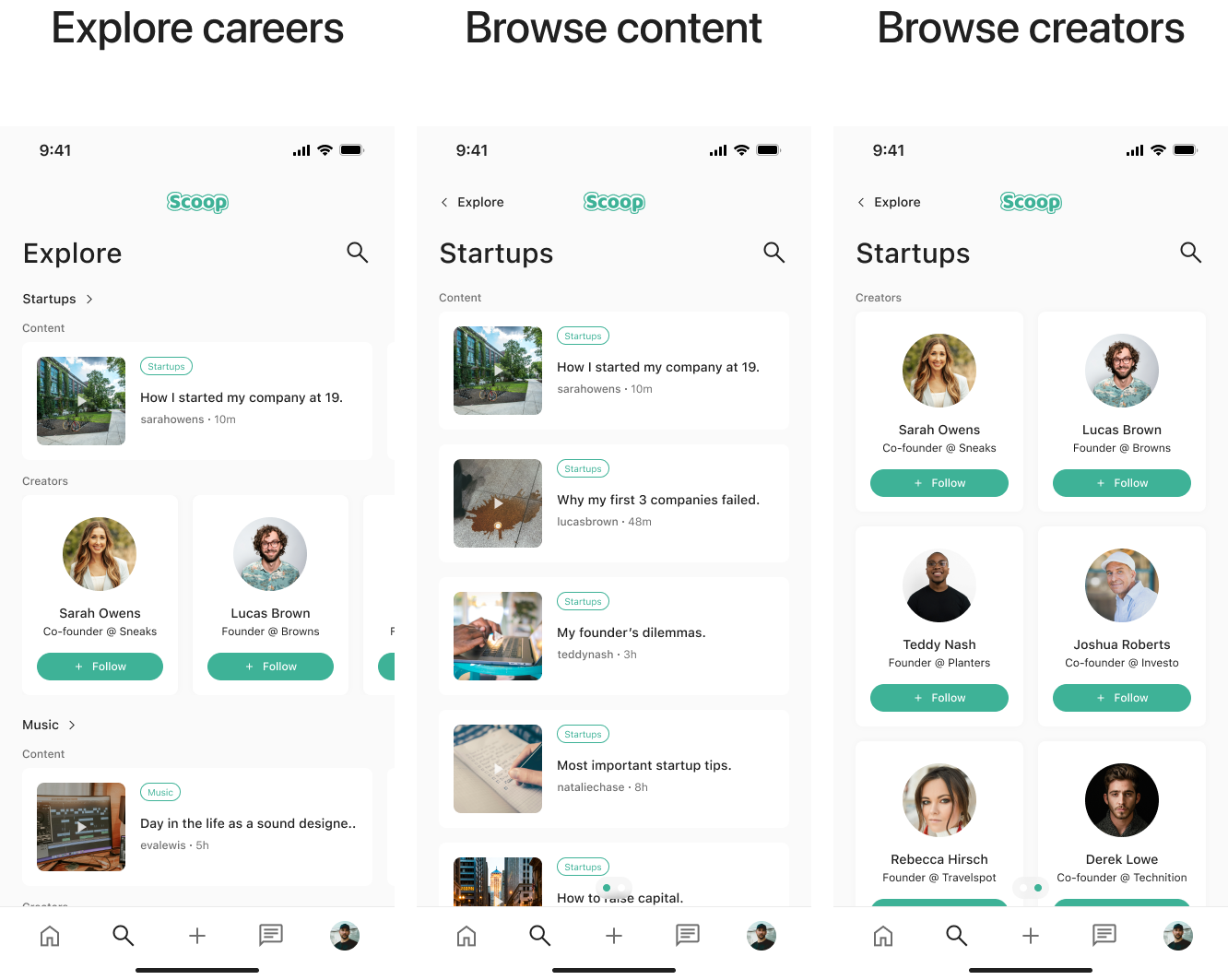
The page features a personalized feed of user-generated content designed to delve deeper into the interests identified on the 'Explore' page, while also incorporating occasional suggestions tailored to user behavior and career preferences. The minimalist design offers a clean, uncluttered interface that helps users stay engaged.

The page showcases a feed of trending questions aimed at fostering community engagement, where users can both ask and answer questions. Its straightforward design facilitates easy engagement with two primary actions: responding to queries and viewing insights.

I've designed over 100 Figma frames and interactive prototypes.
Challenges and setbacks are an inherent part of building a startup, and resilience is what keeps you moving forward. However, true resilience isn’t about blindly pushing ahead — it’s about knowing when to pivot, pause, or even let go. It's the ability to progress, whether that means refining your current path or charting a new one. Shortly after creating Scoop, I recognized its limited potential, and decided to move on to explore new opportunities.
As this was my first startup idea I acted on, I looked to a couple of advisors to guide me in the right direction. While there's no one "right" way to go about exploring a startup idea, there are quite a few wrong ways. Leveraging my network, I had chats with a startup CEO and VP of marketing to help me better understand my next steps.