
Streamlining valet operations.



2022



Have you ever been waiting outside for the valet to bring your car around and wish you could have requested it in-advance? Or maybe you’ve misplaced your physical ticket but after describing your vehicle, the valet retrieves it anyway without any further questions or security measures, making you wonder if anyone could have left with my vehicle?
Growing up in busy Los Angeles, valet parking is often a necessity as parking spots can be hard to come by. One night, while out to dinner, I lost my valet ticket. And despite having no other proof of ownership, I was able to get my car back just by describing it, with no questions asked. That's how I came up with the idea for Queue.
Despite living in a digital age, valet services remain largely non-digital, leading to several consumer issues: unpredictable wait times, lost tickets, cash-only payment method, and overall skepticism and distrust.
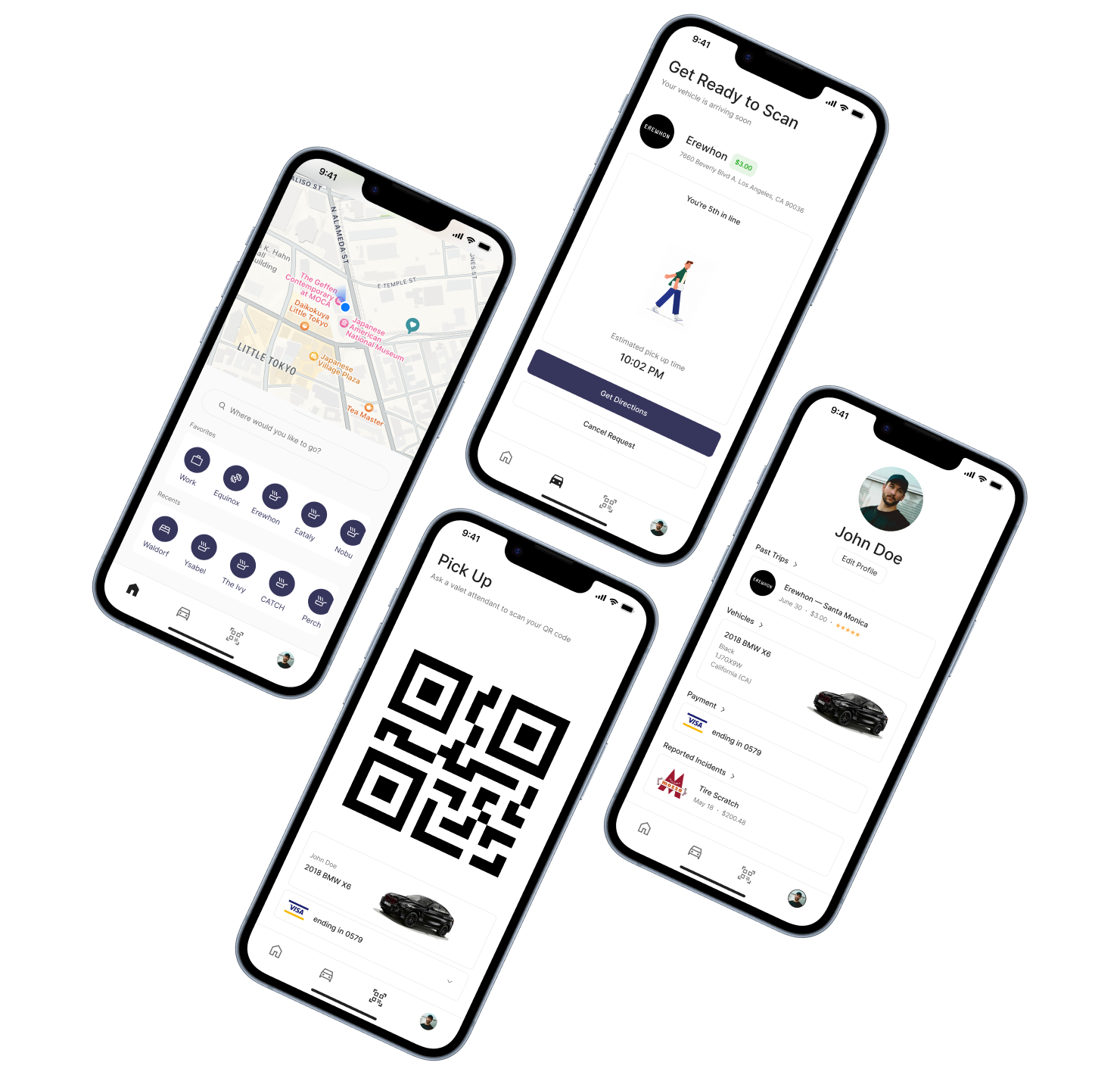
Elevate consumer experience with a valet QR code mobile app. Queue empowers consumers to enter their vehicle specifications and contact information for security purposes, acquire estimated wait times to retrieve their vehicle, request vehicle retrieval, view their position in the queue, rate valet drivers, pay and tip using digital payment methods, and never lose another valet ticket again! With Queue, valet drivers can digitally track their earnings, tips, ratings, and communicate with co-workers, addressing operational inefficiencies.
To better understand the challenges non-digital valet services face in providing a seamless customer experience.
I conducted limited market research and cold called around 20 valet services in Los Angeles.
Unfortunately, my cold calls were met with strong resistance, as most valet services were busy and reluctant to adopt new technology. Nevertheless, I persisted in my market research, observing over 30 valet operations at restaurants and hotels across the U.S., most of which were overwhelmingly cash-only businesses.
From my limited research, three common consumer challenges emerged:
Competitors offer some of Queue's features, but fail to provide a seamless customer experience while addressing valet service operational inefficiencies.

To address the pain points identified in the 'Research' stage and design a user-friendly interface that helps valet services and consumers meet at the intersection of new technological convenience and top quality service.
With the help of FigJam mindmaps, we narrowed our ideas down to two concepts:
Digital QR code ticket system with driver ratings and digital payment methods


Live queueing system to minimize idle and unpredictable wait times, and allow customers to request their vehicles in-advance


I asked several colleagues at USC to check out my project in Figma. Provided Queue remained an undeveloped concept, I did not conduct extensive user testing as would be necessary for a product intended for development.
Participants were asked to perform a few tasks designed to test overall usability:
1) Edit vehicle information
2) Drop off vehicle
3) Request vehicle
4) Pick up vehicle
5) Rate valet driver
I loosely collected feedback through follow-up interviews.
Challenges: Participants found it confusing that 'Drop Off' and 'Pick Up' were combined on one page, and wanted more financial details about the valet service.
Strengths: Participants liked the visual aids and simplicity of the interface.
To address the participants' concerns, I implemented two key changes:
Separate pages for 'Drop Off' and 'Pick Up'
Additional financial details, including a cost breakdown
https://www.figma.com/design/F6JIL68uT7JVlCorvy4y54/Queue?node-id=0-1&t=7g10pLyNpnmJTpOV-1
Here’s how I developed initial wireframes into impactful, user-driven designs.
To streamline the vehicle drop off and pick up process, I created a QR code ticketing system that encodes vehicle specs, owner details, and payment information. At drop off, customers scan the QR code with a valet attendant, which registers the vehicle in the valet system. At pick up, customers scan the QR code to finalize the transaction and process payment. Customers can then rate the driver and add a tip if desired. The design focus was on efficiency and reducing valet security risks.
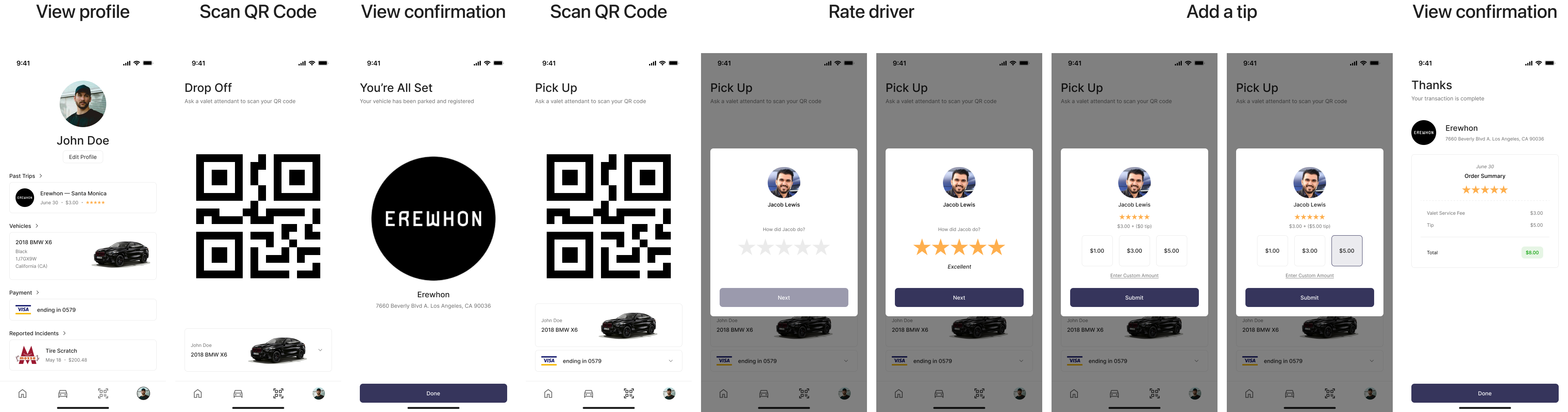
To streamline the pick up process, I created a live queueing system that allows users to request their vehicle in advance, view wait times, track their place in line, and see the estimated arrival time. The primary design goal was to reduce congestion and minimize wait times.

I've designed over 50 Figma frames, and pitched Queue to three USC courses.
Experiencing a problem firsthand is the best way to come up with a truly impactful idea that addresses a deep-rooted issue. The next step is the fun part — doing something about it. I've spent countless hours sitting in my room trying to dream up with the 'next big thing'. Unfortunately, it hasn't worked out too well. My best ideas have always stemmed from personal experiences of frustration or inconvenience that provide a deep understanding of the problem and inspire innovation that can't be replicated by brainstorming alone.
Leveraging Figma prototypes to validate the concept, refine designs, and quickly iterate is an invaluable tool that saves immense time and resources.